

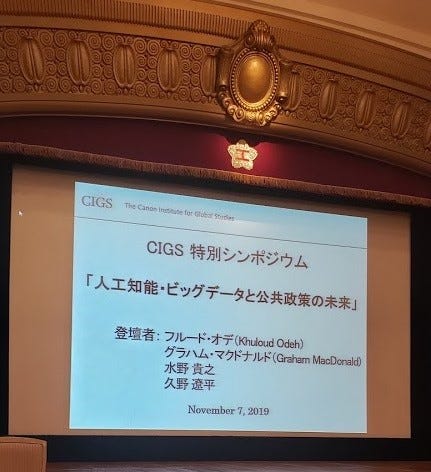
I recently traveled to Japan with Khuloud Odeh, the Urban Institute’s vice president for technology and data science, at the invitation of our counterparts at the Canon Institute for Global Studies in Tokyo. In partnership with the Canon Institute, we presented Urban’s model for using data science in public policy research to Japanese business executives, researchers, and the general public.
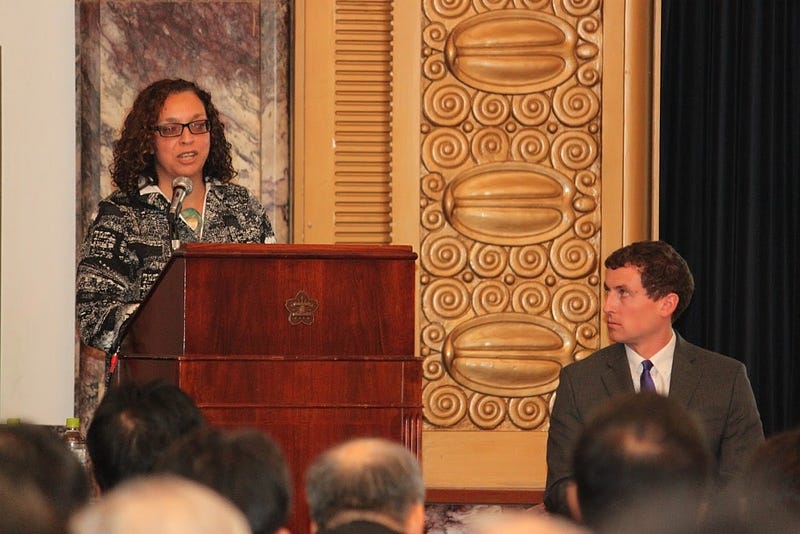
At the symposium and the follow-up academic research conference, we heard from researchers and data scientists from the Canon Institute and several Japanese universities who are pioneering new techniques and analyses aided by cutting edge technology.
In my experience, getting such a broad view of one’s area of expertise across continents and cultures is rare. Even in our brief time in Tokyo, we learned a lot about innovative network analysis techniques, big location data analytics, new causal methods, and others’ approaches to the use of infrastructure in research.
What we presented at the symposium
In our one-hour talk entitled “Empowering Policy Research Institutions in the Age of AI, Big Data, and Cloud Computing,” Khuloud and I argued that Urban’s model for using technology is helping our researchers drive impact.
In our presentation, we told four stories about current and upcoming products that illustrate how Urban is a leading organization in integrating cutting edge data science techniques in complex policy research domains. We believe that technology can achieve the following:
1. help make policymaking more proactive, instead of reactive, through big data analytics
2. put data-driven decisionmaking into the hands of everyone, so we, as a research community, can elevate the debate
3. help us unlock totally new sources of data to tackle existing problems in a new light
We told stories about how:
1. Urban’s current development of a new microsimulation model is a move from reactive to more proactive analysis (using an argument like the one in our Tax Policy Center’s microsimulation model post);
2. our in-development open-data-bias tool is a way to democratize analytics for all;
3. our Education Data Portal is a platform for putting data in the hands of everyone; and
4. our work creating zoning data with machine learning is a way to create new, valuable data to help tackle critical affordable housing issues.
If you’re a regular reader of Data@Urban, you are likely already familiar with many of these projects. So what did we learn from our Japanese counterparts?
Four things we learned from the Canon Institute and other Japanese researchers
In two days of talks, we heard from more than a dozen researchers from the Canon Institute and universities and research centers across Japan, including Gunma University, Kobe University, the National Institute of Informatics, Nihon University, Niigata University, the RIKEN Center for Advanced Intelligence Project, Tokyo University, Tottori University, and Waseda University.
For all these points, the summaries presented are necessarily a limited list; I recommend you check out a full list of their publications via the links provided.
1. Japanese researchers are pioneers of big data–related network analysis techniques at scale, and they are using these techniques to answer critical issues in new, creative ways. This point came across clearly in many presentations. If you’re interested in network analysis or think your research might benefit from it, you should check out the work of some of these researchers:
o Ryohei Hisano, Canon Institute for Global Studies and Tokyo University: Studied huge networks of business institutions, boards, and previous sanction actions to more accurately detect and predict behavior that should, and will, get sanctioned.
o Teruyoshi Kobayashi, Kobe University: Used big data to study the social behavior of banks through networks of interbank loans and how institutional ties often operate similarly to the social ties of friend networks.
o Akira Ishii, Tottori University: Using simulated networks, he studied how trusted ties and influencers affect consensus building in policymaking.
o Takayuki Mizuno, Canon Institute for Global Studies and the National Institute of Informatics: Used the networks of firm ownership and subsidiary structures (PDF) to measure how much governments and other national owners exert indirect influence and power over private sector companies.
o Wataru Souma, Nihon University: Used networks of citations across scientific literature similar to Google’s PageRank to construct a potentially more valuable ranking of influential papers.
2. Japanese researchers are increasingly turning to big, unstructured, spatial data sources to address problems across the policy spectrum.
o Shohei Doi, National Institute of Informatics and Waseda University: Doi presented his forthcoming work using smartphone trace data connected with a large, representative survey to produce a model that labels demographic information of smartphone users based on geographic inputs, which could help detect neighborhood change and trends in real time.
o Takashi Nicholas Maeda, RIKEN Center for Advanced Intelligence Project: Using transit data from many Japanese rail networks and survey data, he is able to decompose trip usage at a granular level, which could help predict and “nowcast” economic changes in real time and with better spatial detail.
o Yasuko Kawahata, Gunma University: Using smartphone data on position and velocity to measure social behavior at the micro scale.
o Joomi Jun, National Institute of Informatics: Using deep learning to classify surnames and predict racial and ethnic composition of businesspeople at the city level to better understand regional variation and changes in country- and city-level composition over time.
3. One research group is working to solve one of data science’s biggest issues: how to appropriately combine causal inference and machine learning, especially in the nonlinear, complex functional contexts in which machine learning typically thrives. For example, we heard from Takashi Nicholas Maeda, who produced the causal decomposition of transit data paper and is currently working with researchers at the Causal Inference Team in Kyoto and Tokyo as part of the effort to develop these innovative methods.
4. Researchers at institutions in Japan face similar constraints as US institutions in adopting new cloud technologies. While speaking with a few researchers (over some delicious sushi), we found many of them were using “free” local resources or buying their own physical servers to do these new cutting edge analyses. Unfortunately, university and research institution budgets seem to be similar in the US and Japan in this respect; pay-by-the-hour cloud computing is seen as an expense against department budgets, while existing servers and supercomputers are “free” because they are paid for outside of team budgets through central overhead. It seems overcoming this hurdle to adopt new, powerful cloud resources will take ingenuity and institutional change, on any continent.
We hope to continue partnering with and learning from leading organizations, such as the Canon Institute for Global Studies, so that we at the Urban Institute, and the field of public policy research in general, can continue integrating data science techniques and technologies to produce new, better, faster, and higher-quality evidence that shapes decisionmaking and improves people’s lives.
